[hand] [face]
The Original Deep Purple Web Pages
The Highway Star

The loudest jazz band in the world

There are several old-ish features on Louder (online successor to the Classic Rock Magazine), done by Geoff Barton and published over the past few years.

February 2015 saw a series of profiles on individual band members that were published in anticipation of the R’n’R Hall of Fame induction. Unlike the HoF people, Geoff knows his arse from his elbow and included all band members (well, apart from Satriani, but in his case there are arguments that can be made).

On April 18, Lou Reed, Green Day, Ringo Starr, Joan Jett and others will be inducted into the Rock And Roll Hall Of Fame, joining everyone from The Beatles, the Stones, Led Zeppelin, Pink Floyd and The Who to Kiss, Metallica, ZZ Top and, er, ABBA. But what about all the bands this US institution has overlooked, ignored or wilfully snubbed over the years? The giants and innovators of rock, prog, punk, blues and more who weren’t deemed important enough, cool enough or American enough to warrant entry through those hallowed portals. Nearly 50 years after forming, Deep Purple are the greatest band not to be in the official Hall Of Fame. They are one of a diminishing handful of bands who formed in the late 60s who are still active today, who are not content to rest on their laurels and who still exist in a meaningful and creative way. While many of their peers are content to play the chicken-in-a-basket circuit – their tour posters emblazoned with monochrome mug shots of how they looked back in their bushy-tailed heyday – Purple have matured like a fine, expensive wine (a Sweet Burgundy, as their former guitarist, the late, great Tommy Bolin, might have it). From 1968’s Shades Of Deep Purple to 2013’s NOW What?!, Purple’s passage through time resembles a mountain range of breathtaking highs and turbid lows. On the next several pages, via a series of interviews with every key member past and present, we celebrate Purple’s extraordinary, multi-decade career. We highlight the radically different personalities of the musicians who have impacted on the band, and marvel at how these contradicting characters were able to gel musically. We examine the mysterious – and occasionally devious – workings of this at times most volatile of bands. We analyse the contributions of alleged bit-part players including Nick Simper, Joe Lynn Turner and the aforementioned Bolin. Plus much more besides. This is Deep Purple dissected, deconstructed and laid bare. (Oh, and we only mention Smoke On The Water once.)

The Real Rock & Roll Hall Of Fame: Rod Evans

The Real Rock & Roll Hall Of Fame: Don Airey

The Real Rock & Roll Hall Of Fame: Tommy Bolin

The Real Rock & Roll Hall Of Fame: Joe Lynn Turner

The Real Rock & Roll Hall Of Fame: Ian Paice

The Real Rock & Roll Hall Of Fame: Glenn Hughes

The Real Rock & Roll Hall Of Fame: David Coverdale

The Real Rock & Roll Hall Of Fame: Ian Gillan

The Real Rock & Roll Hall Of Fame: Ritchie Blackmore — is an interview with Ritchie Blackmore that is said to date back to 1975. Strangely, it mentions him quitting Purple in the 70s as “for the first time”.

The Real Rock & Roll Hall Of Fame: Nick Simper — one of the rare interviews with the man.

The Real Rock & Roll Hall Of Fame: Steve Morse

The Real Rock & Roll Hall Of Fame: Jon Lord

The Purple theme continued later in 2015 with an extended writeup of the band in 1973, including the transition from Mark 2 to Mark 3 and subsequent release of Burn. Paice, Hughes, and Coverdale were interviewed for the feature that appears to have been done to promote the anniversary remaster of Burn. Albeit most of our readers are familiar with the story, it’s nice to have some t’s crossed and i’s dotted:

Seventy-two had been a busy year for Deep Purple: they’d recorded the Who Do You Think We Are! album in cantankerous mood, and had spent most of the rest of the time grimly ploughing the road in the US. Although record sales and concert attendances were climbing rapidly, band-member relationships were disintegrating in inverse proportion. The chief clash was between Gillan and Blackmore; they were at loggerheads, loath to even acknowledge each other’s existence. But the band’s hard work was definitely beginning to pay off: ’73 saw Purple being named the biggest-selling Billboard album act of the year.

But that was no cause for celebration in a group that was threatening to implode. Keyboard player Jon Lord, for one, moaned that Purple’s music was stagnating, while Blackmore continually sniped at Gillan and grumbled about being fed up with his lot. “I’m writing about eighty per cent of the stuff but the credit is being split five ways; I’m not getting any respect,” the Man In Black complained.

In fact, Ritchie had been the first to think about leaving when, in late ’71, he had arranged some studio time with Purple drummer Ian Paice and the aforementioned Phil Lynott. The project was called Baby Face and Blackmore talked about it openly in the music press at the time, much to Gillan’s exasperation. Gillan was further enraged when Blackmore began to tell anyone who would listen how much he admired Paul Rodgers as a singer.

Casting his mind back to Baby Face, Ian Paice remembers today: “It really came about when Ritchie and I were mulling over the idea of trying out something in a trio form. We liked the idea of a trio because it gives you a lot of freedom – you have to fill in all the holes; there’s nowhere to hide.

Paice elaborates: “We both really thought Phil Lynott’s voice was great and his whole persona was a wonderful thing to behold. So we decided to try and get something together in the studio. But the upshot of it was that, at the time, although Phil looked great and he sang great, he didn’t play the bass very well! He got better very, very quickly but to start off with he had a great deal of trouble tuning and staying in tempo.

Continue reading in Louder.

This was followed up by Coverdale, Hughes and Lord recalling the rapid rise and equally rapid fall of Purple Mk IV in Deep Purple: Exit The Man In Black…:

It was a hot Hollywood afternoon in June 1975 when a tall, bright stranger in geisha boots strode into town.

“He looked great; he had this Native American look about him,” Jon Lord remembers. “He walked in and said simply: ‘Hey, guys!’ Tremendously hail-brother-well-met in that laid-back Californian way. He had an astonishingly attractive Asian woman in tow. She was resplendent in a short fishnet dress with nothing on underneath. It took me a very long time to concentrate on the Hammond. I had other organs in mind.”

“He had on green chiffon pantaloons, like something out of Aladdin,” David Coverdale chuckles. “He was visually more exotic and flamboyant than anything I was expecting. A beautiful-looking boy.”

Two months prior to the arrival of this strutting mystery man, on April 7, the Mk III version of Deep Purple had played their last ever gig with Ritchie Blackmore at the Palais des Sports in Paris. The guitarist’s departure had come as no surprise. The remaining members of Purple – frontman Coverdale, bassist/vocalist Hughes, keyboard player Lord and drummer Ian Paice – had known of the Man In Black’s disgruntlement with the band’s musical direction for some time.

Bonus feature: David Coverdale: How We Made The Coverdale Page Album — more than 20 years later, Coverdale looks back on how it all came together and why the project remains one of rock’s great ‘what ifs’…

Well, that’s a lot of catch up reading to do, but then again — it’s boxing week, so… 😉

Thanks to Vladimir Drybushchak for the heads up.

It’s been a year

Episode Six outside Regent Sound studios in 1964

Roger Glover posts his end-of-the-year message:

It’s been a year since I last posted. Somehow, life slips by without warning. I do read all the posts you send, grateful that you take the trouble to share your thoughts and questions. I shall answer some in due course. The lovely words for my birthday leave a warm feeling my heart, thank you.

I eschew social media––not one to share the trivia of my everyday life with the world-–so this site is one of the few ways I communicate stuff. If only I did! I don’t believe in New Year’s Resolutions, but if I did I would promise to post more on this site. As my primary school teacher once noted, “Needs improvement”. Should do better,

A stack of random moments from the year…

Continue reading on RogerGlover.com

It was worth the wait

And we’ll leave you to contemplate your Sol Invictus with this little gem from Finnish hillbillies Steve’n’Seagulls:
Continue Reading »

The polar expedition is over

A picture of the band from what appears to be a photo session for the new album has popped up a couple of days ago on the Instagram of a German photographer Ben Wolf.

Ladies and gentlemen, behold the band embracing the Elwood Blues aesthetics.

The way we look together presents a uniform image of strength and organization. Don’t say anything. Look mean. No smiling.

Deep Purple, promo shot Dec 2019

Thanks to Deep Purple Tour Page blog for the heads up.

Legend that grew bigger than the band

In The Studio with Redbeard celebrated the 35th anniversary of Deep Purple reunion and release of Perfect Strangers by repackaging some contemporary interviews with Ian Gillan and Roger Glover.

Thanks to BraveWords for the heads up.

The vagabond life of Ossy Hoppe

Glenn Hughes and Ossy Hoppe, December 2019

Dead Daisies are at the studio again for a second round, and an old friend dropped by — Oskar ‘Ossy’ Hoppe, who was a Purple roadie back in the 70s. A few years back trade magazine IQ did a profile on the occasion of Ossy’s 65th birthday (issue 59, May 2015, pp. 34-48), including some anecdotage of him starting in the Purple universe in 1973 as Ian Gillan’s personal assistant, eventually being promoted to the band’s tour manager, then looking after the spinoff bands — Rainbow, PAL, Whitesnake, IGB — before settling back in his native Germany and becoming a successful promoter there. Check it out.

Thanks to Yvonne for the info.

Art and history exhibition donates the proceeds

Roger Glover + ??? + Ralf Schmidt with proceeds of the exhibition

The Deep Purple Art and History Exhibition that was held in Spring 2018 in Cologne, Germany, came to a conclusion of sorts. The exhibition netted 1500 euros, and while Roger Glover was in the neighbourhood recently, these proceeds were donated to charities. On Roger’s suggestion a children cancer initiative and a homeless initiative in Cologne got 750 euros each. Both cheques list the artists who participated in the exhibition, with Roger personally signing the cheques (nice touch!)

charity cheque signed by RG

Thanks to Ralf Schmidt for the info.

Tuesday, we made another album

deep-purple-tickets-2020

Ian Gillan, in his own whimsically cryptic way, confirms that the band has finished the new album to be released probably some time in spring 2020 and followed by a tour:

[…] now we gird our lions (yes, I know, but I’m in Africa) for a year of febrile activity into which a rare amount of planning has been invested; obviously not by us.

I sense the grinding of campaign wheels, the oiling of creaky roadies, rumours of itineraries and ripples of creativity in Hamburg. Quite plainly something is in the air; but I have no idea what it could be.

Perhaps, after another brief hibernation, all will become clear, in the spring of 2020.

More of his cryptic whimsies on the official site.

The tour in question keeps materializing from the thin air, with another batch of European dates posted today. These run in late September through late October, and include Sweden, UK, Luxembourg, Germany, Italy, Switzerland, France, and Netherlands. Tickets go on sale in the coming days. Check our calendar for further details.

Thanks to Lutz Reinert for the info.

The ham-fisted philosopher

DP&Rainbow 1968-1979 every  album, every song

An outfit called Sonicbond Publishing has a new-ish book in their ‘every album, every song’ series — Deep Purple & Rainbow 1968–1979 – Every album, every song. It came out in June 2019, but slipped completely under our radar. Now there’s even a Czech language edition available. An Amazon review by Short person (yeah, right) reads:

This song-by-song guide is unusual in that it crosses bands, from the inception of Deep Purple mk.1 in 1968, through to Rainbow’s 1979 album Down To Earth. Author Steve Pilkington, a music journalist and rock magazine editor, includes content from actual conversations he has had with members of the bands about incidents and anecdotes recorded in the book, as well as historical facts gleaned from extensive research. Each chapter features a section on the album’s background and a paragraph about the sleeve design, followed by a description and analysis of every track. If there are any known B-sides or other associated material that didn’t make the album cut, these are also given attention, all handled with light-hearted humour, making it an easy read and giving rise to several genuine laugh-out-loud moments! Any book of this nature inevitably includes a fair whack of personal opinion of course, but as it happens I found myself agreeing with most of it. There is an in-depth description of the dramatic background to Smoke On The Water and a stonking section on Highway Star, in which the author has done a good job of capturing the breathless excitement of the track itself. He’s obviously a fan but is candidly honest about the lowlights as well as the highlights. I really enjoyed this book! Go on, you know you want to …

The book is available from your nearest Amazon outlet, or from Book Depository with free worldwide delivery. ISBN: 9781789520026.

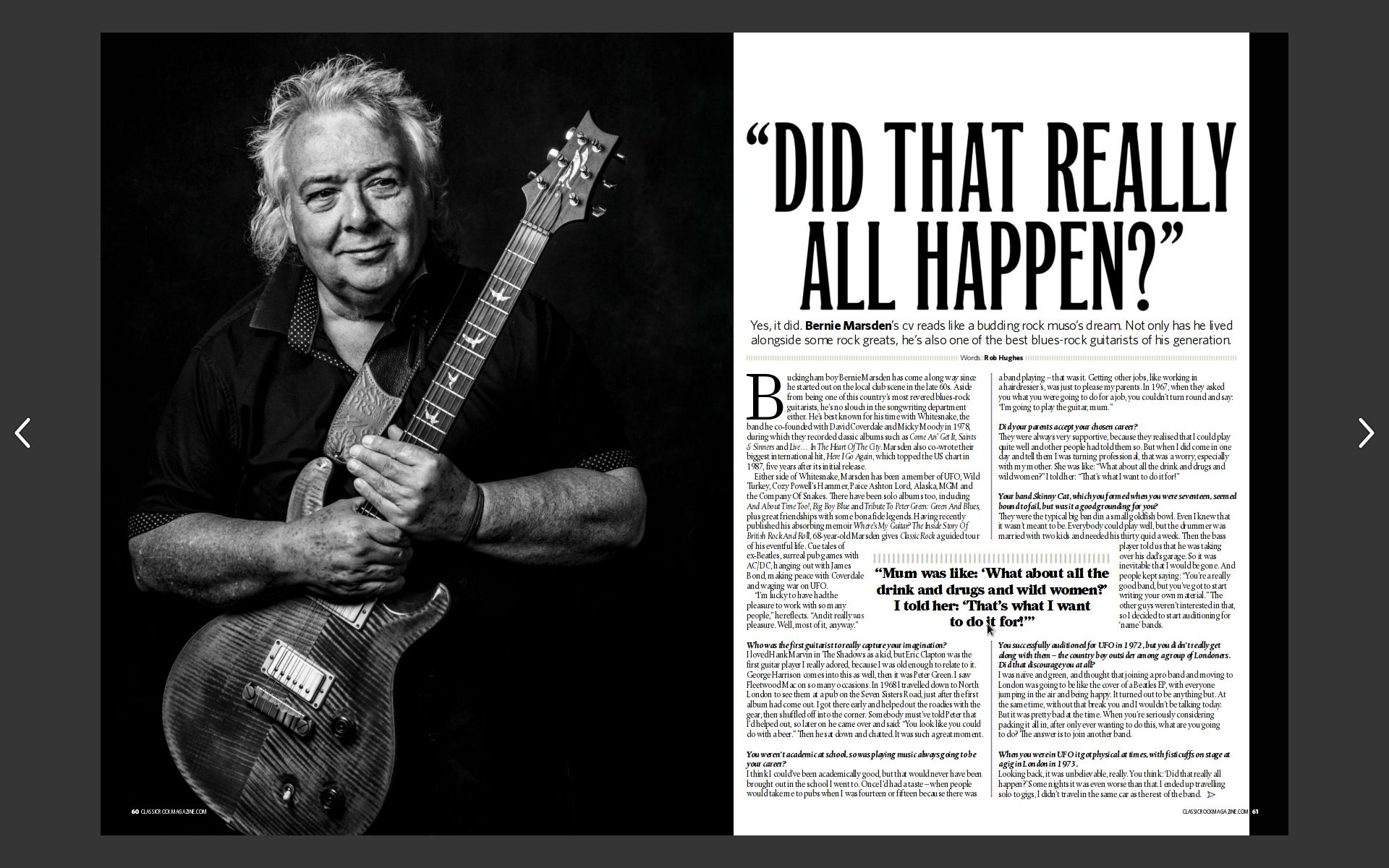
Bernie Marsden’s book Where’s My Guitar? that was financed via pledgemusic.com a couple of years ago, has now been released by a “proper” publisher. Publicity blitz ensued, with excerpts being published by GQ and Mirror. The GQ story deals with recording of Come and Get It at the Tittenhurst Park, a stately house and studio at one time owned by John Lennon and Yoko Ono.

There were still light switches embossed with “John” and “Yoko”, among a fair few other little touches that had been retained by Ringo Starr, who had not lived much in the house since he bought it in 1973. As I explored, I found what I called the “Imagine” room, which had featured in the video of the song and retained the famous white piano and a jukebox. It looked just as it had on screen, with its lovely bay windows and shutters. I felt a tremendous vibe and I had to pinch myself a couple of times. I came back and sat down at the piano one afternoon, attempting a version of “Let It Be”. Jon Lord walked in to find me ham-fistedly attempting to play the legendary instrument. Finding myself on the end of an appraising stare, I slowly removed my hands from the hallowed keys.

“Get away from that piano, Mr M.”

“Yes, sir, sorry, Mr Lord, sir,” I replied. I knew my place.

You could walk for 40 minutes or more in the gardens, alongside gigantic trees and exotic flowerbeds to a man-made lake – the man being John Lennon. I took out the same boat that you can see John and Yoko in Gimme Some Truth. Moody, who couldn’t swim, refused my offer to row him, even though the water was less than a metre deep. He missed his chance to be my Yoko. There was a two-seater wooden bench by the lake and we used Moody’s penknife to carve “J loves Y” in one of the arms. BBC Radio 1 DJ at the time, Nicky Horne spotted the graffiti when he interviewed David by the lake for Newsbeat and the discovery of John and Yoko’s simple love token was much discussed live on the air. Oops. Micky also half-buried an old coffee mug that he inscribed with “John”, hoping it would be unearthed years hence as an object of great reverence.

Read more at GQ.

The Mirror story focuses on Bernie being recruited circa 1989 to ‘harden up’ Cliff Richard’s sound.

The book is available from your nearest Amazon, with the UK store currently listing it as #1 bestseller in ‘Musical Philosophy & Social Aspects’ and ‘Guitars’ categories, and #5 in (i kid you not) ‘Philosopher Biographies’:

Bernie Marsden Where’s My Guitar? Amazon UK rank  2019-12-01

Thanks to Viktor Steinbach and BraveWords for the info.

The Voice of Rock Candy

Glenn Hughes Rock Candy magazine #17

Glenn Hughes is on the cover of the latest (December 2019/January 2020) issue of British magazine Candy Rock. Inside is a 14-page article based around an interview with the man. BraveWords has quotes of him praising Gary Moore:

I’ve played with the greatest guitar players of them all – people like Tony Iommi, Ritchie Blackmore, Joe Bonamassa, Steve Vai, Joe Satriani, Brian May – the list is endless. But for me Gary Moore was the jewel in the crown. To sit next to him on my couch and to see him play with those insane fingers and come up with those insane melodies, well it was out of this world. I’ve sat with a lot of guitar players, but this man spoke to me directly.

What’s a shame is that Gary was close to me in the ’80s when I wasn’t at my best. I worked with him on his Run For Cover album in 1985, but he had to let me go.

Gary was Gary. When he decided he was going to do something then he did it. He was compassionate and sensitive, but at the same time you didn’t want to mess with him. But what I never, ever heard Gary say was, ‘I’m so much better than that guy’ or ‘I’m the best.’

Individual issues of the magazine are available for purchase online.

Thanks to BraveWords for the info.

||||Unauthorized copying, while sometimes necessary, is never as good as the real thing
© 1993-2026 The Highway Star and contributors
Posts, Calendar and Comments RSS feeds for The Highway Star