My previous copyright rant sparked a lively discussion with Mike Eriksson who argued
Personally, I still buy my music and my DVD´s and I do not like all this downloading. If somebody, like this author, wants to give his stuff away for free, good. The problem arises when somebody wants his or hers work protected…
To which I’ve replied that artists who are actively fighting the free (as in free beer and as in free speech) sharing of their works are extremely shortsighted.
Ars Technica has a report from the frontline trenches of the music business (if you go there, make sure you read both parts). The report hails the times they are a’ changin’, where “from distribution to promotion to actually making money, indie bands are doing more than just getting by without the major labels—they’re actually thriving” with the help of not only such services as Tunecore, CD Baby and the venerable Myspace, but also using the power of, ahem, free downloads to promote their music:
Not only do many indie artists hate DRM, but they view P2P is a force to be harnessed, not something to waste energy fighting. The folks from Panda Riot recounted a story about their album showing up on BitTorrent and a number of other P2P networks—somehow, they found a site that listed how many times the album had been downloaded and they saw that it was relatively high. “At first, we were going to send a takedown notice, but then we decided to keep it up and see what happens,” Cook said. So… what happened?
“Well, our sales doubled.”
To anybody who is following the copyright debate here in Canada, this should not come as a surprise. In 2006 Canadian Recording Industry Association (which comprises Canadian subsidiaries of the Big Four labels) commissioned a study on the effects of digital piracy on their bottom line. The big labels being what they are, of course concluded that we need new draconian laws to protect their business models and enable their wet dream — so that customers would have to pay repeatedly for the same product. However, the study contained some very interesting numbers, which led to the following analysis from Prof. Michael Geist (University of Ottawa, School of Law):
In summary, CRIA’s own research now concludes that P2P downloading constitutes less than one-third of the music on downloaders’ computers, that P2P users frequently try music on P2P services before they buy, that the largest P2P downloader demographic is also the largest music buying demographic, and that reduced purchasing has little to do with the availability of music on P2P services.
Coincidentally, free sharing solves two major problems on both sides:
- On the musicians’ side — the biggest problem is not piracy, but obscurity. Even for well established bands like our heroes, vast majority of the people who have not bought Rapture of the Deep are not those who downloaded it illegally, but those who haven’t even heard that Deep Purple have a new album out.
- And on their, errm, consumers’ side, the biggest problem before the advent of free downloads was very low availability of the “try before you buy” concept as applied to music.
That’s why I am still convinced that the artists who oppose to free distribution of their works have every right to do so, but it is extremely shortsighted to do so.
Not every right that you have should be exercised all the time.
![[hand]](/hs-pics/portraits/hands/gillan7.jpg)
![[face]](/hs-pics/portraits/faces/mcbride1.jpg)







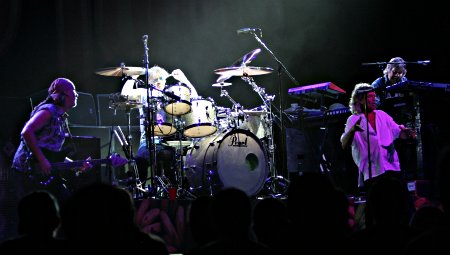
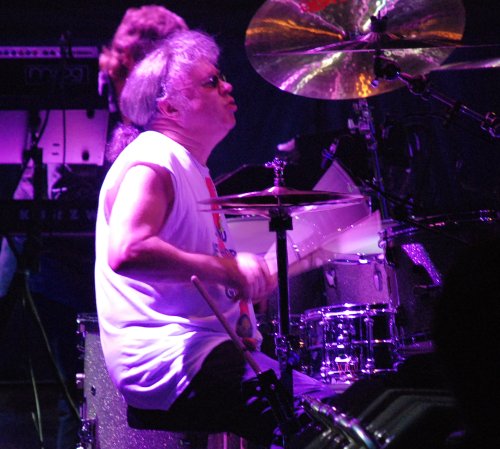
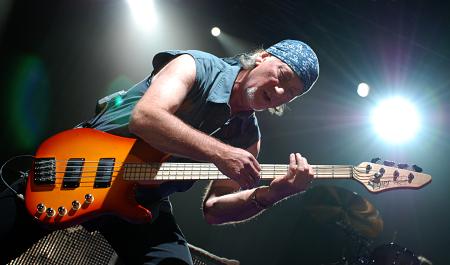
 Unauthorized copying, while sometimes necessary, is never as good as the real thing