![[hand]](/hs-pics/portraits/hands/gillan4.jpg)
![[face]](/hs-pics/portraits/faces/morse3.jpg)




Before We Forget – the story of Jon Lord
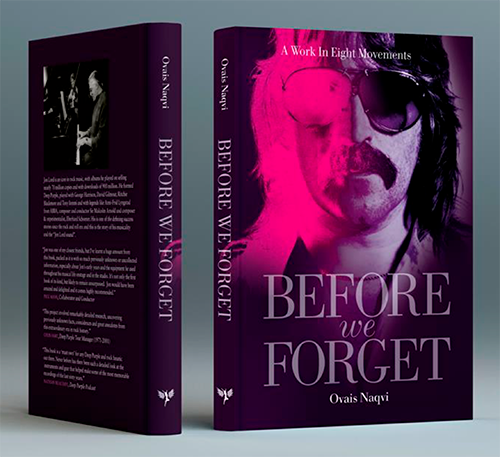
Before We Forget – the forthcoming biography – offers a point of view on Jon Lord and his career and life as a musician that is unique, newly researched and which promises to fascinate the nerds and enlighten the casuals.
The Highway Star’s Rasmus Heide has read excerpts of the book and spent time with author Ovais Naqvi discussing Jon Lord and the book.
From Hammersmith to biographer
 London-born Ovais Naqvi’s own first hand experience of Jon Lord was at Whitesnake gigs at the then Hammersmith Odeon in the 1980s. Mesmerised by what he saw and heard from the charismatic figure dominating stage right, Naqvi would continue to follow Jon’s career for the next decades.
Spur Naqvi on to talk about Jon, and fascinating insights, nerdy background details and respectful accolades flood forward. Naqvi is both knowledgable and passionate about the subject of his book, but he is also keen to stress that he didn’t set out to write just another copy/paste biography on Deep Purple’s and Whitesnake’s famed keyboard player.
Asks Naqvi:
– How could a kid growing up in austere 1950s Britain, become so adept at so many forms of music? Jon could play jazz, blues, R&B, soul and pop and compose orchestral music, alongside co-inventing decibel-breaking heavy rock, all with equal facility. With what kind of a musical brain – and with which tools – did he manage to achieve all that?
– My objective was to build a biography that would celebrate Jon Lord’s genius and to approach him from the direction of sound, instrumentation and musical DNA. That is, in essence, what drove this amazing journey.
To achieve this, Naqvi applied a meticulous approach to research as he dug deeper than the accolades usually piled onto Jon Lord as both a musician and a human.
Consequently, Before We Forget portrays Jon Lord through details of his musical upbringing, a detailed look at the music that inspired him as well as – and this is the fascinatingly nerdy part – the instruments on which he wrote and performed his music. As such, Jon’s story is told through facts rather than through anecdotes.
Musical childhood and inspirations
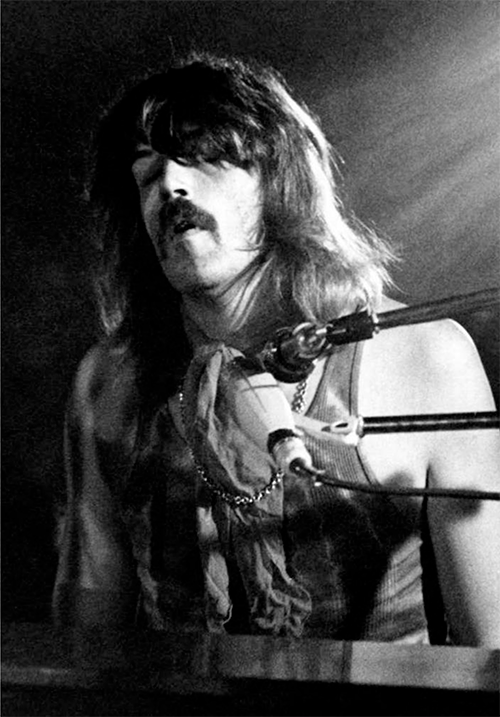 Two years in the making, Before We Forget features all-new insight into Jon’s childhood and teenage years from Jon’s four years younger brother Stephen and from people who studied under Jon’s second piano teacher Frederick Allt.
From a very young age Jon took piano lessons with very accomplished teachers. By employing first rate teachers with a liberal approach to music, Jon’s parents showed how much they believed in a nurturing approach towards his development, explains Naqvi.
There was always music around the Lord household, and Jon was brought up with a very open approach to music. After dinners at an aunt and uncle’s house, the family would often gather and play music together.
Later, when Jon was 16, a part time job at a men’s clothing store would allow him to start buying records and these would include everything from Edward Grieg to Paul Anka. One of Jon’s school teachers guided him towards jazz and consequently Jon would explore both Miles Davis and Gerschwin’s Porgy and Bess. By the age of 17 and still in Leicester, Jon’s theoretical knowledge about music and exposure to different types of music was already surprisingly vast, as Naqvi points out:
– It straddled European classical music, English popular music, contemporary chart music and modern jazz, like Maynard Ferguson and Dave Brubeck. And by the time he got to London in 1961, a vibrant live scene opened up his eyes to the yet edgier sounds of R&B and the blues.
From Hammonds to synths
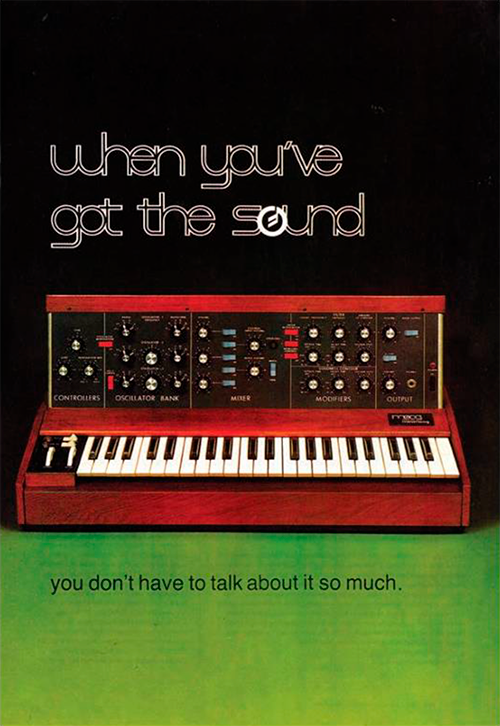 To cover Jon Lord’s musical equipment, Naqvi talked to some of the most knowledgeable people; Lowrey, Hammond and early synth experts, veterans among Deep Purple’s road crew as well as the specialists familiar with Jon’s instruments. Combined with painstaking research, Naqvi has dissected Jon’s setup of instruments from 1965 to his final recording sessions in 2011.
Before We Forget includes full identification of all the seven Hammond organs Jon Lord played on a permanent and long-term hired basis in Deep Purple and Whitesnake between February 1968 and September 2002. Furthermore, it identifies all the local Hammonds, Lord played on a hired-in basis in his solo career from 2002 to 2011.
– Jon gets labelled as a ’Hammond player’ and he had no shame in that. It was his flagship instrument. However, he also sometimes got unfairly labelled as ’only’ that. I wanted to show – and prove – that he not only pushed that instrument into uncharted territory, but that he was also surprisingly open to other sounds, as long as they served the music.
– In my book, between 50 and 60 other keyboards and effects units are catalogued by era and by tour and album – a quite forensic exercise. He knew his way around the synth world perhaps more than even he was willing to recognise. Modesty and selective memory played a big part in that, explains Naqvi.
Book excerpt from chapter 4: We’re Gonna Make It:
”At the start of this new era [Deep Purple Mark 3], Lord stopped using the Marshall Major amplifier and the Marshall “Plexi” PA cabinet alone and returned to pairing them with Leslies, resulting in a noticeable shift in his Hammond sound from the Deep Purple Mk II studio and live albums to Burn – an example being the spectacular organ solo on the new album’s title track. Lord’s Hammond sound immediately felt melodic and more “airy”, reflecting something closer to progressive rock given the album’s title song and its stylised musical and abstract lyrical content. Lord returned to using Leslie cabinets alongside the Marshalls on all subsequent studio and solo albums and in live concerts to the end of his tenure in Deep Purple and into his solo career after 2002.”
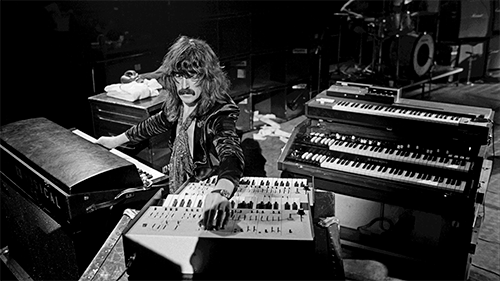
While Jon Lord’s name is synonymous with the Hammond organ, he also worked extensively with synthesizers that would feature prominently in his playing from the mid 1970s and onwards, probably peaking around the late 1980s on Deep Purple’s The House of Blue Light album.
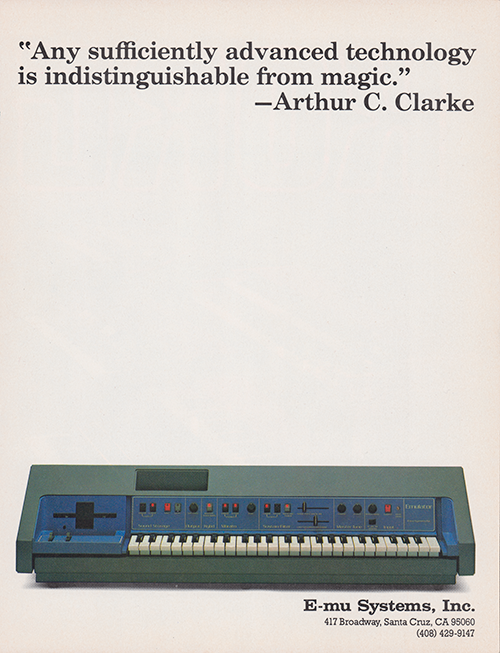 Keyboards like the RMI 300B Electra-Piano, the Fender/Rhodes Mk I 73. the ARP Odyssey 2800, the Polymoog and Memorymoog, Yamaha CP-80, DX1 and DX7, Emulator I & II and the Korg M1 workstation, amongst various others, feature prominently on Deep Purple and Whitesnake recordings and live. Unpicking some of those sounds and later, samples and patches on recordings, was an exercise in itself.
Thus, the biography also contains a definitive summary of all the recording and onstage keyboards and effects units he used in the same period – quite an array of electric and acoustic pianos, monophonic synths, polyphonic synths, effects units, sampling units, MIDI synthesisers and by the 1990s, offstage keyboard modules and expanders.
Book excerpt on Jon’s use of the Hohner Clavinet D6:
”Across 1976 and into the early-1980s, the Hohner Clavinet D6 sat above the Hammond, with the ARP String Ensemble positioned above it, creating a somewhat towering four-tiered keyboard stack that one cannot miss in music videos and concert footage of the period.”
”The Hohner Clavinet (D6 and Clavinet/Pianet Duo models) remained highly favoured by Lord across the mid-197os and into the Whitesnake era. The Clavinet was used to create funky, rhythmic scene-setting on songs such as Ghost Story from Paice Ashton Lord’s Malice in Wonderland, the intro to Whitesnake’s She’s a Woman from the Ready an’ Willing album and across tracks uch as Girl from Whitesnake’s 1981 album, Come an’ Get It. The Clavinet was also deployed to establish the core rhythmic pattern on Hollywood Rock and Roll, from the Before I Forget solo album that was released in June 1982.”
Key career points
All of Naqvi’s research on Jon’s musical equipment is woven into a study of Jon’s musical styling and techniques and insights into his compositional career and shows an adventurous and explorative musician with hugely varied influences.
Along the way, Naqvi’s narrativ expands on a few crucial turning points in Jon’s career.
For one, Jon’s – and Ritchie Blackmore’s – classical inspiration wasn’t all about Johann Sebastian Bach. Edvard Grieg, Tchaikovsky, Vaughn Williams and others should also be mentioned on a list of inspirations that show the broad eclecticism of Jon’s classical taste. The book identifies 20-25 classical pieces, from Thomas Tallis to Samuel Barber (that’s four centuries of composition), that featured regularly in Jon’s music – and that’s only a start.
Secondly, Jon Lord wasn’t so much inspired by progressive rock – players and friends like contemporary keyboard front runners Keith Emerson and Rick Wakeman – as he was by rhythm’n’blues and even jazz-rock. When Glenn Hughes started pushing Purple towards black music and Ian Paice’s drumming started getting funkier and more groovy, Jon would join in with ideas and a playing technique that came more from jazz and black music, including from artists like Stevie Wonder.
This was rarely something Jon would talk about but you can hear it in the music, says Naqvi and points to Jon’s performances on his First of the Big Bands album with Tony Ashton as well as on Deep Purple’s Stormbringer album and later on Paice Ashton Lord’s Malice in Wonderland.
Thirdly, Naqvi refutes the idea that Jon was forced into playing heavy rock on In Rock when really he wanted to play more classically inspired music after the Concerto for Group and Orchestra. Naqvi describes in detail Jon’s efforts to develop a heavier sound by dropping the Leslie amp and plugged his Hammond straight into Marshall amps. This wasn’t the work of someone reluctantly going along, Naqvi points out.
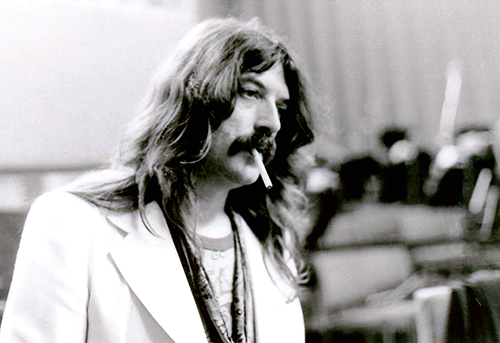
In September 1976, Jon Lord came straight from the Come Taste the Band sessions with Deep Purple in Munich to rehearse and record the Sarabande album at Oer Erkenschwick near Dortmund.
Inspired career decisions
In 1995-96, Jon found himself at a crucial turning point in his professional and personal life. Deep Purple’s mark 2 reunions had run their course, nearly twenty years had passed since Jon’s last major solo work (Sarabande, 1976) and then within a year Jon lost both his parents.
However, this devastating loss seemed to ignite a renewed period of contemplation for Jon. Around the same time he seemed to discover a spark of fresh energy from sparing with his new Purple partner, guitarist Steve Morse, and viewed together Jon’s new circumstances in life seemed to reinvigorate his creative energies and spur him on to compose and record a peerless masterpiece in the intensely emotional and very personal Pictured Within album.
Furthermore, running into Marco De Goeij in Holland who had transcribed large parts of Jon’s original Concerto for Group and Orchestra also seemed to whet Jon’s appetite for new career challenges. Thus, once the Concerto had been fully resurrected at the Royal Albert Hall in 1999 and toured the world the following year, Jon gathered the final courage necessary to leave Deep Purple in lieu of a full blown solo career.
– It’s almost like Jon came to a realisation of ”what are you doing?”, reflects Naqvi today.
As Jon concentrated more on composition, his live performances all over the world became more infrequent – invariably always together with orchestras – and the instrumentation became secondary.
The nature of Jon’s touring activities procluded shipping a Hammond organ out to very concert, and so he played all his solo shows on local hired-in Hammonds, all of which are detailed in the book.
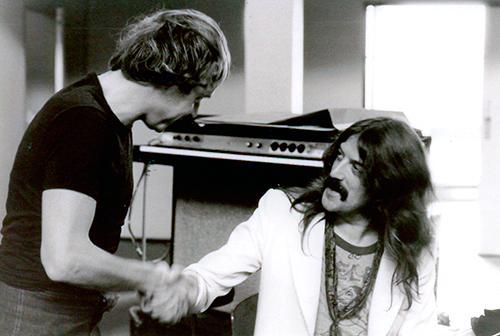
Another rare photo from the Sarabande sessions. Jon Lord greets Klaus Weber, Philharmonia Hungarica trumpet player. Behind is Jon’s custom Fender/Rhodes 73, used on tour in 1975.
The personal solo years
While Jon was often reticent to credit himself and talk about himself, during the solo years 2000-2012, his music attained an autobiographical spirituality where his attitudes and his beliefs were allowed to shine through.
Naqvi mentions To Notice Such Things (2010 album) as a musical work that shows hints of family values, is laced with melancholy and airs of both sadness and hope. In Naqvi’s words, Jon’s personal side is described as strongly ”English” with a firm belief in freedom of expression whatever the implications but also with a strong insistence on harmonious co-existence. Jon was suspicious of politicians and double talking in general.
Thus, through his research, Naqvi arrives at a portrait of Jon’s personality that is a careful reflection of the musical openness, free of prejudice, that permeated his career of both performing and composing music alone and with others.
For the book, Paul Mann – conductor, friend and curator of Jon’s musical legacy – has provided important insights into Jon’s ways of working and his meticulousness particularly in his later years after leaving Deep Purple.
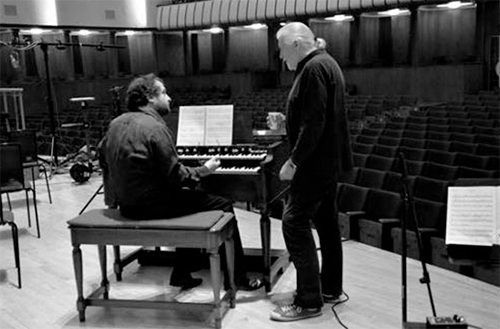
Conductor Paul Mann with Jon Lord during rehearsals for the Concerto for Group and Orchestra sessions at Liverpool Empire in June 2011.
”Greater than any other player”
In short, Before We Forget promises an exciting, enlightening and thorough journey through Jon Lord’s musical life, brimming with details and gently told through the people who knew Jon as a musician and as a friend.
Let’s conclude this preview with Paul Mann’s succinct take on the relationship between Jon’s music and his equipment:
”Jon’s concern was above all with sound and in all the years I knew him, I don’t remember him ever talking very much about the equipment he used. The range of colours he could get from the Hammond organ was greater than any other player I’ve ever heard.”
Before We Forget by Ovais Naqvi hits UK stores in April. Right now, pre-orders are available for a 250 copies only edition signed by Paul Mann and the author through https://beforeweforget.store/
 Unauthorized copying, while sometimes necessary, is never as good as the real thing
I have just pre ordered the book. Thanks so much for this information, it looks a good one indeed. February sometime apparently. Cheers.
January 5th, 2026 at 22:56Big fan of JL since In Rock first came out. Does anyone know how much this book will cost in the US? (The regular version, not the 250-copy limited edition.)
January 6th, 2026 at 00:56Thank you for mentioning this 😊
January 6th, 2026 at 07:26He was a marvellous musician 💜
Concerning Jon’s use of Marshalls: there was a cleaner much less distorted sound to Jon’s Hammond after Purple imploded in ’76, you can hear how different it sounded in Whitesnake, where Jon’s role was was more supportive rather than how strident and upfront it was during his Purple years. It sounded different until Steve Morse joined, and it was he that encouraged Jon to return to his earlier, more aggressive Hammond sound.
January 6th, 2026 at 18:44Now where is the accompanying boxed set compiling all of Jon’s solo works as well as some highlights from sessions, soundtracks and his work with The Artwoods, DP, PAL & WS? I’ll gladly give some input!
https://www.youtube.com/watch?v=It1CmC-Fr7Q
https://youtu.be/EWV2Pj2WO08
https://youtu.be/3fl429HDA0E
And what a stereo remix of Sarabande (already then a well-produced album) could do today!
Or his songs with Norwegian singer Maria Arredondo (Jon arranged plus played piano and organ)?
https://www.youtube.com/watch?v=TMku_JOWVms
https://www.youtube.com/watch?v=1uOYBBwmz-0
https://www.youtube.com/watch?v=5ni_E_dglIc
Pitifully documented as available music releases go, our Jon, he really is.
January 6th, 2026 at 20:26I love Jon’s Hammond sound from 1974 to 1977 (Mk 3-4, Sarabande, and PAL). I preferred it even over the beast he created for Mk 2.
I will be looking out for the regular version of this book once it releases.
January 6th, 2026 at 22:18Thanks, Uwe, for the links – I had forgotten about that.
January 6th, 2026 at 22:47Got my signed copy ordered. Hopefully, it will be a worthy companion to “Jon Lord : All Those Years Ago,” released by Jon’s family, and Jerry Bloom’s “Jon Lord : A Visual Biography”, which are both on my bookshelf. “All Those Years Ago” is absolutely superb – wonderful family pictures of him and the other Purple guys, testimonials by many who knew Jon – it’s a treasure. And Jerry Bloom’s book is also an excellent read with great pics. This one sounds like it will take a slightly different tack, with all the technical info on Jon’s instruments. So I’m looking forward to it.
Regarding Jon’s sound, I must admit that it took me a while to adjust to his Marshall amp driven sound (which he lovingly called “The Beast”). I was especially taken back initially when I first heard Machine Head – where was that gorgeous Hammond Leslie sound that I was so addicted to? It took me quite a few listens to get past that and start to realize how well the “growl” worked in the MH songs. And it certainly was unique and became (more or less) his “trademark,”, so I did jump on board – albeit not immediately. But now I love it. I think Jon struck a bit of a compromise later, especially on “Burn” and when they reformed in ’84. Part of Jon’s genius to me was knowing when the music was better served by the sweeter Leslie sound, and when “The Beast” was the way to go. He certainly was a musician without prejudice in his love of all genres – how many times did he say, “at the end of the day, it’s all music?”
January 7th, 2026 at 01:38The “Gorgan” had at one point run its course, it made sense to retire that specific sound. It was a bit garage’y/undergroundish, and Purple’s band sound became more refined over time.
Jon in an interview once described his role with Ritchie as being “the oil to his vinegar, a good mix” and with WS as “providing a halo for the two guitars, that was new for me”.
January 7th, 2026 at 02:39It must be a fantastic book that honors the genius of the Maestro.
Everyone remembers the work on the Hammond that made Jon an unrivaled legend, but I would like to draw attention to the work on the synthesizers done in the 80s in PS and THOBL, a truly refined and elegant sound research, more amalgamated in the excellent sound picture in PS, more of a protagonist in THOBL.
January 7th, 2026 at 12:22I would define his use of synths as wise and intelligent, but then again Lord is the ‘Maestro” for a reason.
Jon continued to use “the Beast” effect throughout his career when he felt it served the music, as I’m sure you know, Uwe. This is one of the last of his collaborations before he was diagnosed with pancreatic cancer, and he talks about modifying the organ he used to get the “growly sound” (at about 20:50 in the video, he says, “it’s growling, it’s purring”) to describe the sound he was seeking. This is a terrific video of the Maestro at work. And again, you can just feel the “gentleman personna” oozing out of him as he talks to the studio techs and other musicians (including Big Ian). Well worth the watch!
https://www.youtube.com/watch?v=GhsOCUVHGjs
January 7th, 2026 at 16:01Stone me, but I liked how Jon worked the synths on THOBL & S&M. He was tasteful doing so.
January 7th, 2026 at 16:43The reason I am jumping on this Jon Lord release so quickly is that I missed the 2014 one, ‘All Those Years Ago’ that George @ 8 mentioned. Fat chance of picking that book up anywhere, oh well, not to worry. Mind you, it was expensive wasn’t it, British pounds sterling. A true collectors item indeed and Australian dollars to that price would have doubled it for us convict bred islanders, woe are we! Whether this book is as limited in its availability over time remains to be seen. Cheers
January 7th, 2026 at 21:36#Uwe – thanks for reminding us of the Iommi-Gillan film. Such terrific footage. Just lovely seeing them all together.
January 7th, 2026 at 22:24Didn’t Jon use Hiwatts in his rig during the Tommy Bolin era? Both Tommy and Glenn used Hiwatts in Purple.
January 7th, 2026 at 23:31Poor George in Ohio has morphed into Uwe … 😱🤣
January 8th, 2026 at 01:20Cheers just ordered the Paul Mann signed copy. Interestingly when WHITESNAKE headlined Reading Rock Festival (1980) pick up was from Jon’s Burntwood House pile – namesake of lovely track on his Before I Forget LP?
Ps – transportation for the band consisted of 4 Rolls-Royce Phantom VI limos…
Cheers – PJ
January 8th, 2026 at 10:34Where can I order this book ? Thanks for any information. Keep on rocking from Graz, Austria
January 8th, 2026 at 11:15Hey, if I have to morph into someone else – I could certainly do worse…
January 8th, 2026 at 14:44MacGregor, if you ever get to my part of Ohio, you have an open invitation to look at my copy. It wasn’t cheap – can’t remember the exact cost, maybe $150 US at the time – but whatever it was, it was worth it. The following 4 minute promo video shows some highlights of the book :
https://www.youtube.com/watch?v=ioWXUdoax30
January 8th, 2026 at 20:06@ 21- thanks George, it was your comment that reminded me of that book. Then I went looking online (knowing that it wouldn’t be available, but you never know) and then I watched that four minute clip. I know how I missed that in 2014, selling and moving house at that time during April. Too busy with other things in life and it slipped past me. It is a true collectors item indeed. Thanks for the invite. The Australian dollar would have had that at about $300, or even more depending on its value at that time with the US or British currency. This new book was $72 Australian plus $40 postage. It is like a constant tariff of sorts living out here in no mans land. It must be our convict past that we are still paying for, he he he. Cheers.
January 8th, 2026 at 21:03#17: Who shared limo?
January 10th, 2026 at 08:34Ron Wood reminiscing about the Yardbirds, Jeff Beck and Jon Lord gets a mention too. Cheers.
https://www.loudersound.com/bands-artists/ronnie-wood-jeff-beck-jimi-hendrix-jon-lord
January 12th, 2026 at 11:39Sneaky little Jeff didn’t want any competition! (Thanks for the interview, Herr MacGregor!)
Ron Wood is btw Gene Simmons’ favorite bass player, he loved his work with the Jeff Beck Group and has lauded him repeatedly in interviews as his greatest influence.
This song features Ron playing the bass too:
https://www.youtube.com/watch?v=KbI_awR4CKE
Don’t be misled by Ronnie Lane miming to it on this TOTP performance where The Faces backed Rod Stewart though Maggie Mae was a solo hit by him, not a Faces number. The bass line is Ronnie Wood, not Ronnie Lane (a very good bass player and singwriter in his own right).
If you listen to the bass track closely, then it is striking how
– on one hand melodically brilliant,
– on the other hand how rhythmically sloppy and all over the place it is! 🤣
But that is the brilliance of Ron Wood on a first take. Years later, Gene Simmons would tribute his bass playing style here:
https://www.youtube.com/watch?v=mQxr4tsTUj8
January 13th, 2026 at 10:12I can understand Jeff Beck not wanting another guitarist ‘getting in the way’. His style and ‘pastiches’ of other peoples songs and music doesn’t warrant another guitarist and keyboards as we often say, are much more colourful as an addition to electric guitar in a rock band. Excepting a few bands that we admire at times, Wishbone Ash and early 80’s King Crimson perhaps, for my liking at least. I am not a big two guitar band aficionado, it has it’s place though, just a little here and there, a bit like a three piece blues rock band, good for a while, but not my favourite band setting overall. Interesting that Gene Simmons was influenced by Ronnie Wood’s bass playing, something Wood probably only did for a year or two by the sound of it. Did Jeff Beck ever have two guitarists once he evolved from the early 70’s era. Apart from his short stint with Jennifer Batten in the late 90’s. Although Batten was substituting for a no keyboard led lineup. It is a very good concert that one, she is a fine guitarist and compliments Beck really well. I don’t follow all of Beck’s forays, just a few little era’s, early to mid 70’s, a little in the late 80’s and that dvd concert from Japan with Batten. I did re watch those JBG live clips with Cozy, Clive Chaman, Max Middleton and Bobby Tench yesterday. Interesting also that Beck played with a lot of different bass guitarists and drummers, he seemed to enjoy ever changing rhythm sections over his career. Cheers.
January 13th, 2026 at 21:53@25
“Did Jeff Beck ever have two guitarists once he evolved from the early 70’s era. Apart from his short stint with Jennifer Batten in the late 90’s.”
I was gonna post links to a few examples Jeff playing with other guitarists when I stumbled across this gem and I thought I should share it with you & everyone else here…
https://www.youtube.com/watch?v=0I22e-tXbK0
Oh yes, back to what I meant to do… here’s Jeff playing with none other than…
https://www.youtube.com/watch?v=ee6VSMDyHMc
Another one with…
https://www.youtube.com/watch?v=zUEcDnBMsZ0
January 14th, 2026 at 11:17Jeff with other guitarists is all nice, but it’s nowhere near as cuttung edge as when he plays with someone like Jan Hammer:
https://www.youtube.com/watch?v=cSL8Qv6N5MI
https://www.youtube.com/watch?v=lSc4caThpbU
Not that Steve Lukather does a bad job on the second performance, he’s not for nothing one of Simon McBride’s role models.
January 14th, 2026 at 15:58Sorry guys. regarding Jeff Beck, I should have said permanently touring in the same band with another guitarist. There are plenty of guest appearances over the years. One more recent touring band example I did find was this: “Live In Tokyo was filmed at the Tokyo Dome City Hall in Japan on April 9th, 2014. These Japanese dates were the first to feature Jeff Beck’s new backing band of Jonathan Joseph (drums), Nicolas Meier (guitars)and Rhonda Smith(bass) and the set list includes some material from his new, as yet unreleased, studio album.” No doubt there could be more band lineups that Beck assembled with another electric six string guitarist. According to this Jennifer Batten interview from 1999, Beck hadn’t had another guitarist in his band since the Yardbirds. Thanks for the links. Cheers.
https://www.guitarplayer.com/players/watch-jeff-beck-and-jennifer-battens-dazzling-display-of-guitar-wizardry-on-letterman
January 14th, 2026 at 19:44@26
Jan Hammer brought out something in Jeff. When those 2 got together… lookout.
Damn!!!!!! That video with Lukather has to be the funkiest version of Freeway Jam that I’ve ever heard.
January 14th, 2026 at 19:54@23, 24 – one of Ron Wood’s most notable bass performances was on “Emotional Rescue”.
Where he takes full advantage of all available space in the verses.
It’s Bill Wyman-ish enough to fit in with the other tracks on the record, but a little different, a little busier.
In the video, Bill doesn’t seem to mind miming to Ron’s playing.
January 14th, 2026 at 21:57https://www.youtube.com/watch?v=9iw_BE_X9sA
@ 29 – yes that version was full on in more ways than one. Peruvian or Colombian influences there perhaps. Unless they just consumed a vast amount of coffee before they went onstage. Cheers.
January 15th, 2026 at 09:28It’s too loose and inaccurate for Wyman, Skippy! 🤣
But it exudes Ronnie’s slapdash charm. Not everything needs to be accurate, good sloppiness is an art.
January 15th, 2026 at 20:17Reordered it yesterday and am waiting in anticipation for its arrival. Jon’s music is my most enjoyed, with the Deep Purple albums my abosute favs. The man was a musical genius who could turn to different styles of music without a second thought.
January 16th, 2026 at 18:59Somewhat related: British Hammond-playing rock star reveals how he only got the band back together to pay for his BMW 750iL!!!
https://www.liz-turner.com/woman-driver-blog/remembering-jon-lord-a-true-gent#:~:text=Jon%20Lord%2C%20keyboard%20player%20and%20a%20founder,1988%20was%20one%20of%20my%20most%20enjoyable
https://www.liz-turner.com/uploads/1/0/9/7/10979999/7620956_orig.jpg
January 19th, 2026 at 14:33@ 34 – have to enjoy Jon Lord’s lifestyle choices. I do remember in an interview when he was asked, “what’s it like to be a millionaire”? Something along those lines. Jon’s reply, ‘I have never been a millionaire, however I do enjoy living comfortably’. A good response indeed. Cheers.
January 20th, 2026 at 00:44It is the only time I remember Roger being a little nasty in an interview, this was circa 1982/1983 and Jon, still as a Whitesnake member, had mouthed off in interviews that his commitments were with WS, he didn’t see the point of a DP reunion at all and would only participate in one if it was a one-off event for some worthy charitable cause. And Roger was somewhat cutting in his reply: And I don’t believe that Jon, of all people, would play for free with Deep Purple, not even as a one-off for a worthy charitable cause. Ouch! And he knew him better than we all did! 😂
January 20th, 2026 at 09:16Is there any update on release date, I am still waiting for mine.
March 3rd, 2026 at 14:11I had a personal email that they are in the process of sending it to those who have ordered.
March 3rd, 2026 at 18:38@ 37 – I just received this email update last night regarding delivery of the book :
Dear All:
You will be happy to know we have begun shipping the signed Concerto Edition of “Before We Forget”.
Given print location, logistics and transportation, we’re doing this in batches and have begun in the UK as of this week (copies are with customers shortly) and will then move to Germany, where units ship this week.
Those two markets account for just over 40% of our signed unit pre-orders. We will then batch and ship to the Rest of Europe, Rest of the World and the US.
The support from our channels has been tremendous: Deep Purple Podcast, Nick Foley, The Highway Star and Booked on Rock amongst others. We are shortly to be on Phil Aston’s Now Spinning Magazine channels (with a video interview), Prog Magazine and various others.
Finally, the regular Tour Edition is now available on Amazon UK, Waterstones.co.uk and will be available in bookshops in the UK (for now) by end-March. Do feel free to encourage others you know to pre-order.
Many thanks for all your messages, emails and kind feedback and grateful as ever, to have been able to put this work together to serve the genius of the one of the greatest of all musicians in rock history, Jon Lord.
Finally, copies are also with key contributors Paul Mann, Colin Hart, Nick Foley, Willy Fyffe and are also with the Estate of Jon Lord and Deep Purple’s manager, Matt Clark, as well as with Roger Glover, Don Airey and Ian Paice. Their responses to date have also been super.
March 3rd, 2026 at 21:24You will be happy to know we have begun shipping the signed Concerto Edition of “Before We Forget”.
Given print location, logistics and transportation, we’re doing this in batches and have begun in the UK as of this week (copies are with customers shortly) and will then move to Germany, where units ship this week.
Those two markets account for just over 40% of our signed unit pre-orders. We will then batch and ship to the Rest of Europe, Rest of the World and the US.
The support from our channels has been tremendous: Deep Purple Podcast, Nick Foley, The Highway Star and Booked on Rock amongst others. We are shortly to be on Phil Aston’s Now Spinning Magazine channels (with a video interview), Prog Magazine and various others.
Finally, the regular Tour Edition is now available on Amazon UK, Waterstones.co.uk and will be available in bookshops in the UK (for now) by end-March. Do feel free to encourage others you know to pre-order.
Many thanks for all your messages, emails and kind feedback and grateful as ever, to have been able to put this work together to serve the genius of the one of the greatest of all musicians in rock history, Jon Lord.
March 4th, 2026 at 00:46I got a mail saying it will arrive ‘in March’….
March 4th, 2026 at 07:14Signed book arrived yesterday No. 258), only time for a brief look thru BUT suprised only Paicy, Roger G, & Steve M, from DP contributes a ‘tribute’ paragraph? Bernie M, Micky M, Paul Mann, Eberhard Schoener & Malcolm Arnold ( quote about music and friendship) and strangly James Taylor (JT Quartet)..all contribute!
March 4th, 2026 at 07:48My copy arrived yesterday, looks like it will be an interesting read, very much the definitive book on Jon’s keyboard history which is very fitting to the kind of man he was, a great innovator and musician! Suspect if you’re looking for the hot gossip or band arguments you need to look elsewhere, amazing piece of work by Ovais.
March 4th, 2026 at 14:30My signed copy, number 200, arrived yesterday. Not had time to read it through yet but it is painstakingly put together, and as a native of Leicester myself, fascinating to read of Jon’s early life there.
March 4th, 2026 at 14:40I could very well see James Taylor (the organist, not the former Carly Simon hubby nor the smooth-crooning singer of Kool & the Gang) being attracted to Jon’s style. Though in the Jazz idiom, I hear similarities.
https://youtu.be/OrK9P7bOkj4
March 4th, 2026 at 17:35RPJ, I wouldn’t read too much into both Big Ian and Ritchie sitting this one out and not contributing anything, we know they are both grumpy old men with their own respective code of conduct. Nothing to see there, please move on …
March 5th, 2026 at 15:56Mine arrived (#002) and I have read it. Principal observations: It’s very well written but it’s very technical. If you want to know exactly what JL’s rig was at any time then this is the book for you! I’m glad I bought it but I found it heavy going.
March 6th, 2026 at 13:27Mine has arrived too today – only glanced at little snippets and leafed through so far. The whole book oozes “thoughtful work”, not fan fiction. Print job and bookbinding reinforce the upmarket feel. I think Jon would have been chuffed.
March 6th, 2026 at 16:43Mine (#142) arrived today. When I saw the picture with two rotten Leslies I had to smile. Looking forward to reading it!
March 7th, 2026 at 16:01This is such a great book and is everything I hoped it would be when I first read about it. This really is a labour of love, rather than a some cut and paste work. The quality of the binding and printing is really impressive as well and really brings the book to life, especially the pictures. Although it’s pretty technical in its subject matter, this is not a barrier. All we need now is a similar tome on Mr Paice.
March 10th, 2026 at 20:17