
Face Your Fear
The Dead Daisies have released another track from their upcoming album — Face Your Fear. The album, called Radiance, is going to be self-published and release date is set for September 30. Continue Reading »
![[hand]](/hs-pics/portraits/hands/morse10.jpg)
![[face]](/hs-pics/portraits/faces/airey3.jpg)



The Dead Daisies have released another track from their upcoming album — Face Your Fear. The album, called Radiance, is going to be self-published and release date is set for September 30. Continue Reading »
For many years the band’s sales numbers have been a mystery — the record industry types like to keep their cards very close to their chests. The total worldwide sales number of 100 to 120 million records had been banged around at some time, without any supporting evidence.
An interesting article appeared on chartmasters.org in 2021 (the whole site is a bonanza for music lovers who happen to be numbers geeks). It gives both raw numbers for album sales and introduces the concept of Equivalent Album Sales. See a quick 2-minute intro video or read all the gory details.
This leads to some very interesting results. The raw numbers for album sales are as follows:
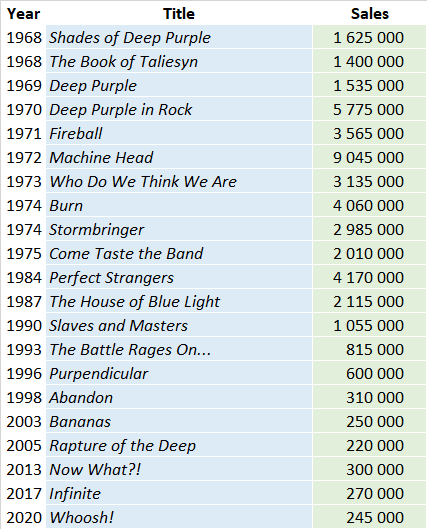
That leaves out a plethora of live releases, countless compilations, singles, offshoot bands, downloads, streaming, et cetera, et cetera. The Equivalent Album Sales (EAS) concept aims at addressing all that.
In short, 1 album = 1 full length music video (think Cal Jam) = 2 EPs = 3.33 physical singles = 6.67 digital singles = 1500 audio streams = 6,750 video streams. Yes, these coefficients are somewhat arbitrary, but they are what they are. You are invited refer to the original article and crunch the numbers with your favourite weights, if you’re inclined to do so.
Live albums and compilation sales are distributed to album sales proportional to how much each album contributes to the live album or compilation (e.g. streaming data suggests that Machine Head tracks account for 85% of Made in Japan listens, so 85% of MiJ numbers are counted towards MH album equivalent sales).
And the final result (drum roll):
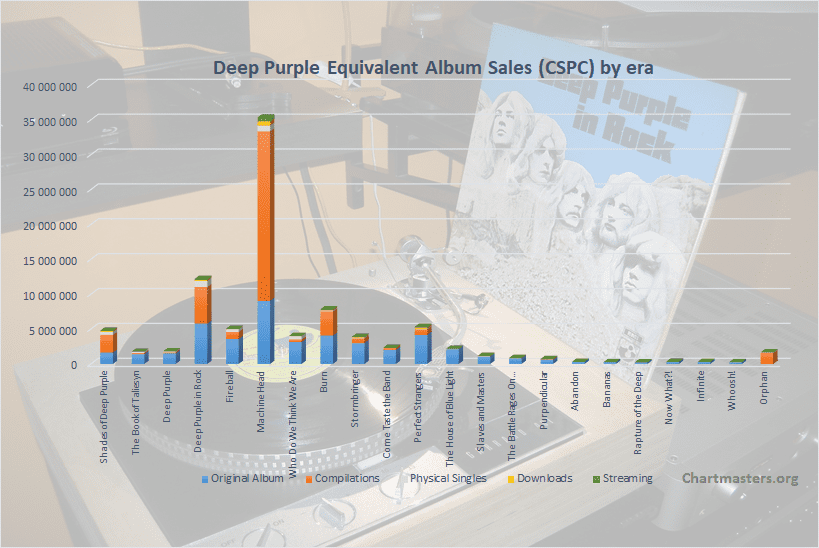
Machine Head gets the largest boost — in addition to 9 million album sales, the final adjusted number gets closer to 35.5 million. That includes EAS of 24 million from live and compilations, 1.3 million from singles, and 750 thousand from streaming. It ends up as the best selling album of 1972.
Other albums with significant EAS boost:
Once all is said and done, total worldwide for the whole career comes to 92.5 million equivalent album sales.
Notable records and achievements:
This is just a summary of a quite a long article. Check the source for full details.
One big caveat thought: the article does not give any sources for the raw sales numbers, and they are the foundation for all results and conclusions, so take everything with a grain of salt.
Edel has posted another video from the Düsseldorf 2005 gig — title track from the just about going to be released Rapture of the Deep. Continue Reading »
In this interview dated April 2022, Simon McBride demonstrates the right mix of cocky and humble, while talking about the differences between being a session man and playing under his own name, fanboying with Ian Gillan, hairspray rock, and other things. Continue Reading »
Fan-filmed super8 footage has come to light from Deep Purple’s 1975 show in Copenhagen. Filmed at Brøndby Hallen on March 20, 1975 by Lars Kroman, the silent and fragmented film lasts nearly 10 minutes.
At first it shows the band filmed from the audience in front of the stage. Later and more interestingly, the camera has moved to an excellent vantage point behind the stage showing exciting views of Jon Lord and Ian Paice with the crowd in the background.
Now, we just need someone to sync it up to the bootleg from the show…
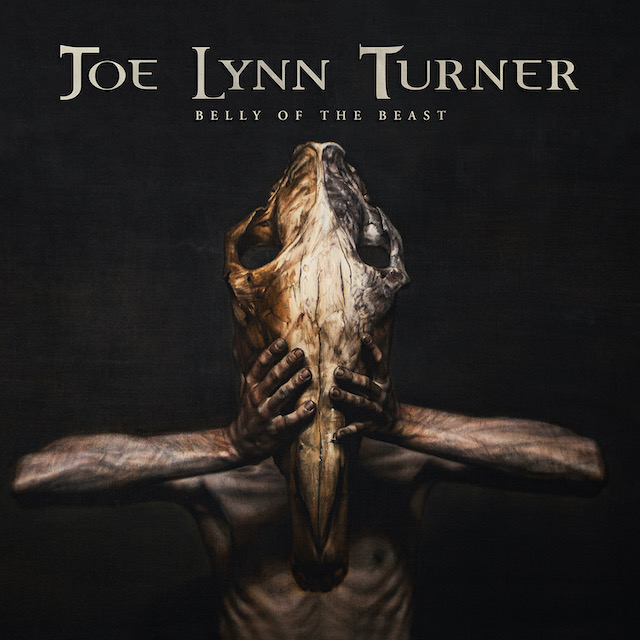
Joe Lynn Turner’ s new album Belly of the Beast is coming out on October 28, 2022, via Mascot.
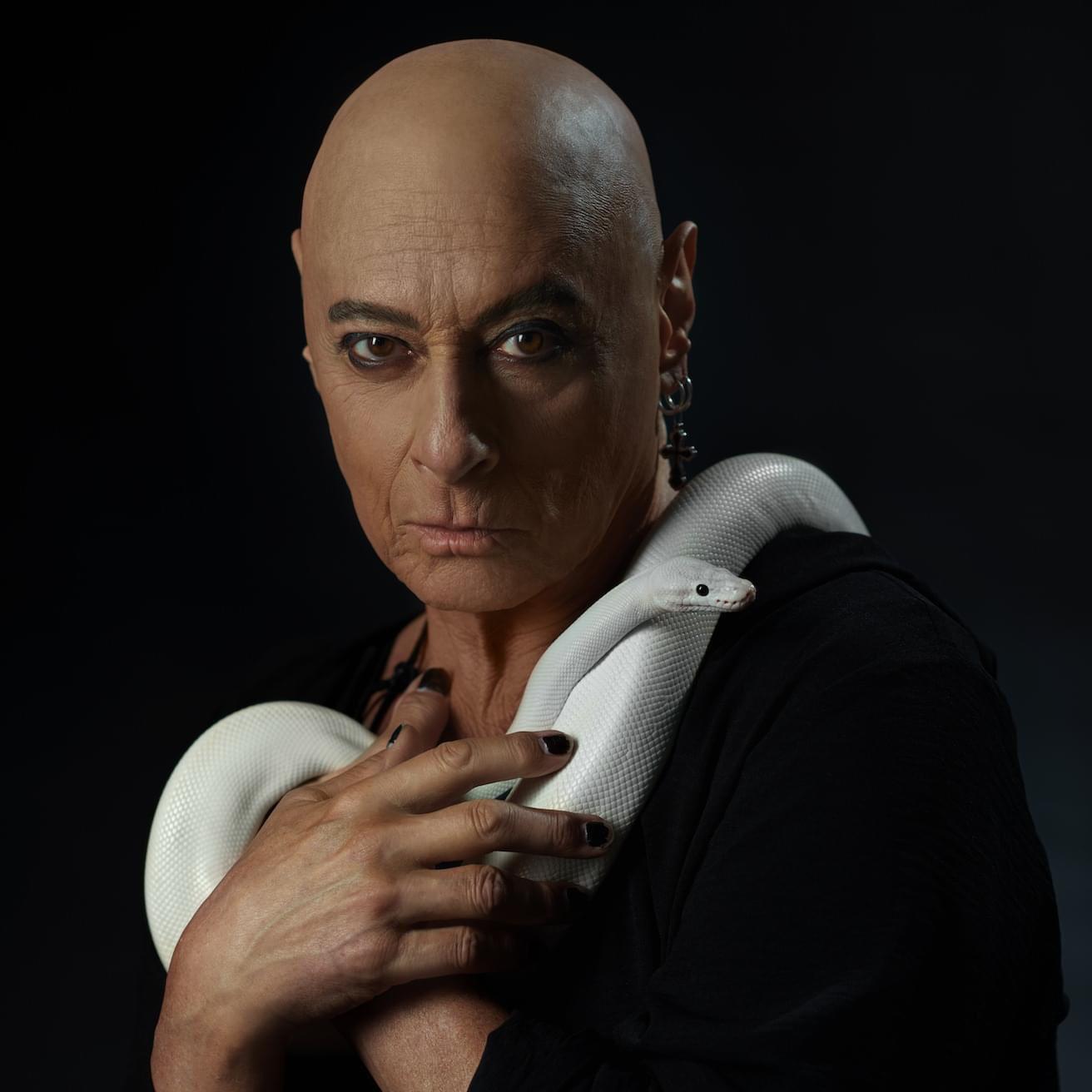
The promo pictures for the release feature JLT au naturel, finally owning up to how he is:
This chapter saw him make a crucial personal decision too. Diagnosed with alopecia at three-years-old, he began to wear a wig at 14-years-old, dealing with “emotional and psychological damage from cruel bullying in school.” So, he wore the hairpiece throughout his career until finally deciding to go without it. “In a way, it’s a blessing and a curse,” he admits. “I have nothing to prove, and I can wear a wig — or not. I am free to do what I want. I’m a grown man, and I’m getting to be an older man. Many men in this business eventually come to the decision to continue to ‘wear hair’ or shave their head which is very fashionable today. Either way, it takes a lot of personal courage. Assholes in high school trying to kick me around made me stronger and gave me the necessary motivation and strength to rise above the rest. Anger and pain are a great tool. If applied correctly, it could develop you to become the best version of yourself. Instead of running away, I was ‘hiding in plain sight.'”
A lyric video for the title track has been posted to promote the album:
Thanks to Uwe Hornung and Blabbermouth for the info.
Elizabeth the opera singer discusses the importance of spit management and hand calluses in her analysis of Smoke from Hosftra’73. Continue Reading »
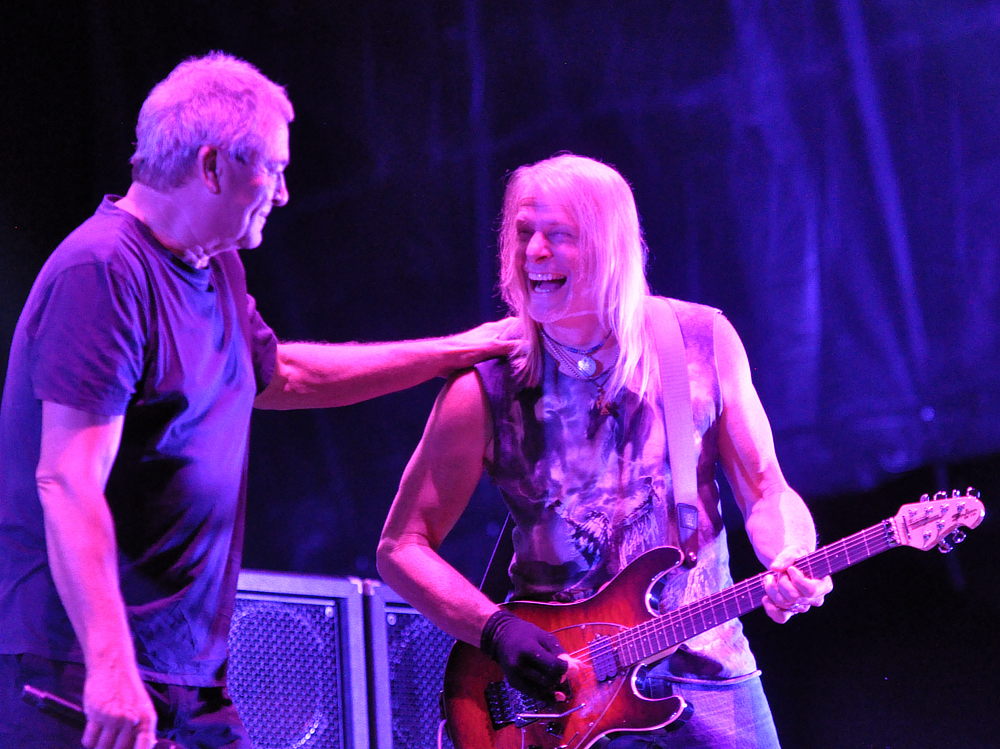
Goldmine prints a brief collection of quotes from Ian Gillan’s interviews to the magazine.
On Steve Morse’s guitar playing
“There’s a solo on a song called “Dancing in My Sleep” (on the Deep Purple album Whoosh!) where he plays a baritone guitar, an old Danelectro, and it’s one of the greatest guitar solos I’ve ever heard in my life. He also plays a brilliant solo on a song called “We’re All the Same in the Dark.” But in general, I guess you wouldn’t have recognized it as Steve’s style 10 years or 20 years ago. It’s more, I don’t know, laid back. Steve’s a kind of frenetic guy. He’s pretty intense with his personality, but he has a lovely, lovely nature. But this sort of slightly more laid-back style seems to suit him.”
Read more in Goldmine
Glenn Hughes and Doug Aldrich spoke to US radio 101 WRIF broadcasting out of Detroit. They spoke about bouts of COVID that went through The Daisies’ ranks, their upcoming album, the terrible Ted, Glenn playing in Detroit at the age of 5 (allegedly), and many other things. Continue Reading »
Elizabeth the opera singer (a.k.a. the lady who forgot about singing more than all of will ever know) analyses Gillan’s take on Gethsemane.
I’m very familiar with this song and have seen it performed many times, but have never seen nor heard the original with none other than Deep Purple’s Ian Gillan! This is going to be a treat for my ears!
Thanks to Mike Whiteley for the info.
 Unauthorized copying, while sometimes necessary, is never as good as the real thing