Glenn Hughes was interviewed recently by Lokaos Rock Show out of Brazil. Here he went on record to admit that he considers The Dead Daisies a side project for him, with eventual return to his solo career. Another Black Country Communion album may also be in the books. Continue Reading »
Paicey reminisces about his first time meeting Ritchie Blackmore and then a year later joining a nascent band Ritchie was forming with Jon Lord and Nick Simper. Continue Reading »
Another Gillan interview in The Portugal News, where he talks about his favourite local hangouts, life on the road now and then, and gives his advice to aspiring musicians:
TPN: The entertainment industry has been hit hard due to the pandemic and I wanted to ask if you could please give any advice to aspiring musicians?
IG: “I can’t give any advice that they want to hear, the only advice I can give is from the bottom of my heart and that is that commercial success in music is one thing and the music itself is entirely different. Just keep practising and work with as many people as you can, broaden your influences, become better, love it, and take a Calvinistic attitude towards music because if you are successful or not, music can be a friend for your whole life, and sooner or later things will improve and I think probably there will be a renewal of energy from across the board, not just for musicians, perhaps with the capacity of people wanting to see live performances. The problem we have got at the moment is that there is so much of everything, there are so many people, there is so much music, the kids today are just as talented, if not more than the generation I grew up in but the opportunity is less because there are more of them and they are all competing for less opportunities whether that is performance, venues or recording contracts which don’t even exist anymore so I would just say love your music and take every opportunity to practise. Every musician I have worked with practises for six hours a day and if you do that you will become adept with your instrument and suddenly one day you will find your voice and express yourself with an instrument the same way as you are speaking.”
Paicey was a guest on a podcast run by one Darren Paltrowitz. Not too too long, but a very interesting conversation about the new album, bonus tracks, 9/8 timing, William Shatner, and Netflix, among other things. Continue Reading »
Jon Lord’s Concerto for Group and Orchestra was performed in Győr, Hungary, on November 5, by a local orchestra with Paul Mann conducting, Bruce Dickinson singing, and Roger Glover blessing the even with his playing. The evening also included a set of Purple classics (with an occasional Beethoven tune thrown in). Continue Reading »
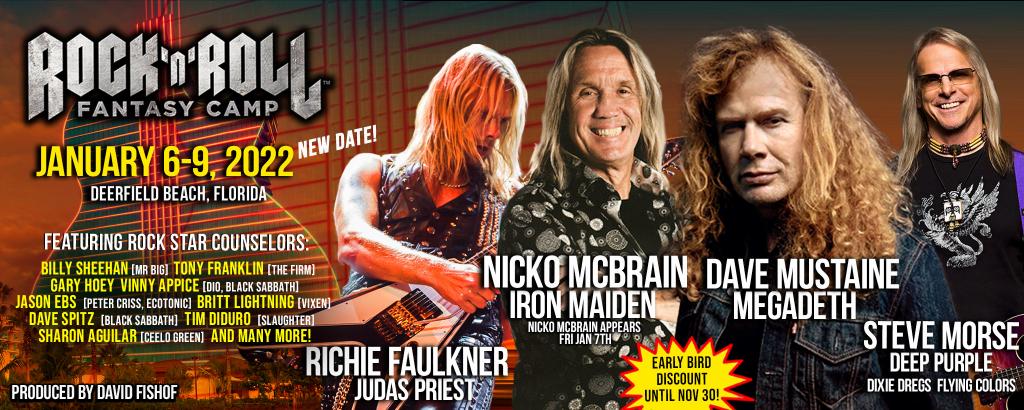
Steve Morse will be once again a guest star at the Rock’n’Roll Fantasy Camp held on January 6-9, 2022, at the Seminole Hard Rock Hotel and Casino in Hollywood, FL (caveat: camp website insists that the venue is in Deerfield Beach some 20 miles to the North). Other guest stars include Dave Mustaine of Megadeth, Nicko McBrain of Iron Maiden, Richie Faulkner of Judas Priest, and producer Tony Bongiovi (Aerosmith, Helix, Meat Loaf, Ozzy Osbourne). Camp councelors (the people with whom a closer interaction is to be expected) include Billy Sheehan, Vinny Appice, Rudy Sarzo, and many more.
Packages start from $5599 ($5999 after November 30th). There are also online masterclasses starting at more reasonable $50. Check their website for full details.
The Dead Daisies have successfully made it across the pond and are now touring the UK. Maximum Volume Music has a positively glowing review of the tour opening gig at the O2 Institute in Birmingham on October 30.
Of course, if the support band is that good, then the main band has got to be top notch, right? Well yes and The Dead Daisies are just about as good as it gets right now.
So, let’s get right to it and say this: “Holy Ground” – the album they put out earlier in the year – is a masterpiece. The only question remaining was this: how good would it sound live? Well, to answer with the barest minimum of hyperbole, it might well be that The Dead Daisies are the finest band of their type on planet earth right now.
As Glenn Hughes puts it later in the set, “we are a new band again”. And the additions of the Cannock legend (and listening to him split his accent between Black Country and West Coast USA is truly something) and drummer Tommy Clufetos have moved them into the Premier League. They know it too, you can tell, from the moment they start with “Unspoken”.
Ian Gillan spoke to The Portugal News on the occasion of a Purple show being confirmed in that part of the world a full year from now, in November 2022.
TPN: What was the inspiration behind “Turning to Crime” and producing the upcoming album?
IG: We normally sit and write and music just comes to us and when we have got enough, we make an album and that is pretty much how it has always worked. The problem is with the quarantine and the lockdowns, it is very difficult to get the band physically together. Steve our banjo player lives in America, Roger our bass player lives in Switzerland and the other guys live in England so it was a major military operation to have rehearsals and we need to be together to write and not necessarily to perform as we have discovered now, as everyone else has, you can do it digitally and remotely. It was our producer’s idea to do “Turning to Crime” and we have always done covers, the first three big hits for Deep Purple were in 1968/1969 which were Hush, Kentucky woman, River Deep, they were huge hits in America and we have performed them on stage but never produced an album of covers. The selection was a really important part of that process, we put up a long list with our producer, Bob Ezra, and talked about it and made a shortlist and ran through ideas and then we started working on them.
TPN: Is there is a particular track on “Turning to Crime” that stands out or one you are excited to perform live?
IG: Actually, there are 3 or 4 or 5… “7 and 7 is” has already been released and is the opening track and it is a song I love and used to perform in 60s in a band called Episode Six. I also love a track called “Rockin’ Pneumonia And The Boogie Woogie Flu” it just such fun and I am excited to sing that live. Another track is an Old Ray Charles track with a Quincey Jones arrangement, Don has turned it into a magical piece of blues jazz and it is so much fun which is called “Let The Good Times Roll” and those three tracks are ones I would select to perform on stage.
![[hand]](/hs-pics/portraits/hands/mcbride5.jpg)
![[face]](/hs-pics/portraits/faces/morse2.jpg)




 Unauthorized copying, while sometimes necessary, is never as good as the real thing